
About Us

Banner: 
Yak

The International Tibet Network is a global coalition of Tibet-related non-governmental organisations. Its purpose is to maximise the effectiveness of the worldwide Tibet movement. The Network works to increase the capacity of individual member organisations, develops coordinated strategic campaigns, and encourages increased cooperation among organisations, thereby strengthening the Tibet movement as a whole.

Network members are committed to non-violence as a fundamental principle of the Tibetan struggle. They regard Tibet as an occupied country and recognise the Tibetan Government in Exile as the sole legitimate government of the Tibetan people. Beyond these principles, the International Tibet Network respects the variety of views and opinions of its member organisations, for example concerning Tibet's future political status, and believes that diversity strengthens our movement.

We currently have over 180 member organisations. The Network's day to day functioning is managed by a small Secretariat, whose work is overseen by an elected Steering Committee. Steering Committee members represent all six continents where there are Tibet Groups.


Campaigns

Candle-light vigil, Warsaw, Poland.

The current priority for the Tibet movement is to "Put Tibetans in Tibet First" and highlight their continued resistance to China's rule.

This resistance takes many forms; from overt public protests - such as those which swept the plateau in 2008 (see below) and resulted in a huge increase in the numbers of political prisoners, and recent protests by students in Amdo (Qinghai) against new policies to reduce teaching in Tibetan to a language subject, - to more subtle "cultural resistance", which emphasizes and celebrates the Tibetan national identity in music, writings and poetry.

Candle-light vigil, Warsaw, Poland.

China has had Tibet in an iron grip since the Uprisings in early 2008; these led to unprecedented levels of globally coordinated activity in support of the Tibetan people. Between May 2007 and August 2008, the Tibet movement ran campaigns focused on the Beijing 2008 Olympic Games. Notable campaigns since include commemorating the 50th Anniversary of the Tibetan National Uprising, and "Tibet Third Pole", a campaign that took the Tibet issue to the Climate Change Negotiations in Copenhagen, December 2009.

The International Tibet Network develops coordinated campaign strategies in a variety of ways, including forming Campaign Working Groups made up of representatives of member organisations, appointing specially chosen Task Forces or working through Campaign Coordinators.

Coordination

The International Tibet Network believes that the global Tibet campaign movement is most effective when its members work together in a coordinated way. To this end, the Network's Secretariat arranges regular Regional Meetings for its member organisations in order for groups to skill-share and engage in detailed strategic planning.

The Network also has two Regional Coordinators, in Asia and in Latin America, who are responsible for building the regional network and assisting Members in finding appropriate regional strategies for implementing global campaigns. They provide support and advice, especially to newly formed groups.

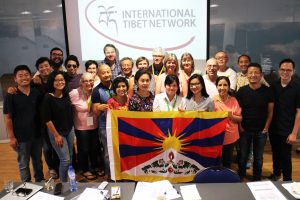
Delegates, Steering Committee Members and Secretariat staff meet in Dharamsala, India, for the Asia Regional Meeting, 2008

Above: Steering Committee Members and Secretariat staff attend a Special International Tibet Support Groups Meeting in Dharamsala, India, November 2012.

Left: Delegates, Steering Committee Members and Secretariat staff attend an Asia Regional Meeting in Dharamsala, India, March 2008.

photo: David Huang, SFT India.


Capacity Building

The International Tibet Network aims to increase the capacity of the movement by helping its member organisations build their resources and increase the skill-base of their campaigners. The Capacity Building programme includes regular training — often in conjunction with Regional Meetings — and a small grant scheme for members to undertake capacity building projects.

Status of International Tibet Network

The International Tibet Network is incorporated in the United States of America, where it holds non-profit 501(c)(3) status. Individual members of the Steering Committee form the Board of the Network and meet annually to fulfil their responsibilities.

Funding

In 2011 the International Tibet Network received grant funding from the Isdell Foundation and the National Endowment for Democracy, the Gere Foundation and Taiwan Foundation for Democracy, as well as donations from individuals. An important part of the Network's funding comes from the annual membership fee paid by member organisations. A copy of the Network's 2010 annual return to the United States Internal Revenue Service can be viewed by clicking here.